Wednesday, March 12, 2008

The CFS campaign

Here are all the interesting websites relating to the defederation campaigns at SFU, Kwantlen, and the University of Victoria:

Pro-CFS:
CFS campaign site for Simon Fraser University: www.yescfs.ca
CFS campaign site for University of Victoria Graduates: www.uvic.yescfs.ca
Camosun College Student Society site: www.cfstruth.org
CFS-BC 'membership development': www.iamcfs.ca
I AM CFS Facebook group

Anti-CFS:
Simon Fraser Student Society site: www.sfss.ca/independence
Kwantlen Student Association site: www.cfstruth.ca
University of Victoria Graduate Students' Society site: cogitoergono.blogspot.com
WE WANT OUT Facebook group (SFU)
Kwantlen students want out of the CFS! Facebook group

Neutral:
The Canadian Federation of Students Debate - A Neutral Forum Facebook group


Also, the CFS has applied to the Supreme Court of British Columbia for an injunction postponing the KSA's defederation referendum to the fall of 2008. The KSA has put up a site listing the documents filed by both sides in this case: http://www.kusa.ca/cfsvsksa
Erin Millar reported on this controversy at Macleans.ca

Labels: , , ,

Monday, January 14, 2008

In other news, the written war has begun at SFU...

From this week's Peak:

Labels: ,

Thursday, January 10, 2008

From the 1981 Founding Congress to the November 2007 National General Meeting!

I am pleased to report that my 'Canadian Federation of Students General Meeting Documents' page is complete - based largely on the archives of the Simon Fraser Student Society - and now contains documents dating all the way back to the October 1981 Founding Congress [PDF]!

P.S.: If you have any documents that are 'missing' from this page, please email them to me!

Labels:

Monday, August 27, 2007

... and now the rest of the meeting

At the same time that the Organizational and Services Development Committee was considering a variety of motions, the much larger Finance Committee was discussing audits and budgets. Calvin Tompkins from Tompkins, Wozny, Miller (TWM) (the auditor for CFS-BC, as well as the SFSS, the KSA, the DSU, and several other students' unions) was present. He was apparently quite shaken up when he learned that the draft financial statements for the fiscal years ending 2003 and 2004 that TWM gave to CFS-BC were presented to the general membership and "approved" by the members at previous General Meetings as "audited financial statements." (Furthermore, the 2004 draft financial statements were not even marked draft.) When Finance Committee representatives asked Tompkins why the statements were so very late, Tompkins said that this was because information on certain transactions was not provided to the auditors.

Although the Finance Committee voted unanimously to recommend the re-appointment of TWM, I strenuously argued against their re-appointment during closing plenary. I noted the following:
  • Auditors have a legal obligation (section 47 of the Society Acti) to complete audits of the organizations that they serve, an obligation that is not impacted by the failure of that organization's management to provide certain financial information; however, TWM failed to do so, spectacularly, in the case of two different organizations: CFS-BC and the DSU. In the case of the DSU, audited financial statements were left uncompleted for three years, and even today the organization is not up to date on its audits.

  • Auditors have the right (section 52 of the Society Act) to access documents and to interview directors, officers, and staff of the societies that they audit in order to obtain the information necessary to conduct their audits. We had no evidence that TWM did so at CFS-BC or DSU.

  • Auditors also have the right (section 54 of the Society Act) to attend general meetings of the societies that they audit, and to speak at these general meetings. TWM had very good reason to speak to the members of CFS-BC and DSU and tell them why (and that!) they (TWM, CFS-BC, and DSU alike) were violating the Society Act - yet they failed to do so.

  • Lastly, I wasn't proposing that CFS-BC should go without an auditor - under section 41 (3) of the Society Act, the refusal of the Semi-Annual General Meeting to re-appoint TWM as auditor would not have any actual effect on their continued status as the auditor. A negative vote would amount, essentially, to censure of the conduct of TWM.
In the end, TWM was re-appointed as the auditor, with the SFSS, the KSA, UVic Grads, and the CSU voting against, and requesting that their dissent be recorded in the minutes.

Now, I should make it clear that I am not faulting the competency of the TWM partners or staff to conduct audits. Rather, I question their independence from management and their willingness to act on behalf of the members that appointed them and use (when necessary) the legal tools that the Society Act gives them, for fear that they might not be re-appointed. TWM auditors, I am sure, are nice people, but I cannot possibly advise my employer to re-appoint them as auditors of the KSA.

In non-financial news:

The Campaigns and Government Relations Strategy of CFS-BC passed, which included a controversial component called "Access for Graduate Students." The SFSS graduate representative and the UVic Grads objected to the campaign's proposal that funds from a BC graduate student grant program be distributed on the basis of need, rather than on merit. (Their arguments are somewhat complex, and I am hopeful that one of them will spell out their arguments in greater detail.) In any event, "Access for Graduate Students" passed despite the fact that every graduate student in the room was opposed to it (the specific details of the component, not the general principle!).

CFS-BC Documents:

Labels:

Saturday, August 18, 2007

Yesterday's Organizational and Services Development Ctte Mtg

So yesterday I attended the Organizational and Services Development Committee (OSD), which is in charge of reviewing motions relating to the services and internal affairs of CFS-BC, as well as reviewing Bylaw, Standing Resolution, and Operations Policies...
  • A motion from the Selkirk College Students' Union to fully subsidize the costs of one delegate to every provincial general meeting was recommended for adoption to plenary.
  • A motion from the Malaspina Students' Union (MSU) to produce "a handbook on best practices in financial management ... as a resource for member local boards of directors and staff" was recommended for adoption to plenary. I moved an amendment proposing that the handbook be produced by "a qualified and experienced third party," citing CFS-BC's lack of qualification in this regard, but OSD voted down my amendment, claiming that the handbook should be made by elected officials and staff of CFS-BC member local student associations who were knowledgable of the specific financial management needs of student associations.
  • Two motions from the Simon Fraser Student Society relating to transgendered, intersexed, and gender-variant individuals were recommended for adoption to plenary. One of these motions required gender-neutral washrooms near all CFS-BC meetings; the other motion directed that a set of practices be developed to allow transgendered, intersexed, or gender-variant individuals to be included within CFS-BC's gender-alternating speaker's list system used during meetings.
  • A motion from the University of Victoria Graduate Students' Society (GSS) to amend Bylaw II to require that during referendum on federating (i.e. joining) CFS-BC the referendum ballot should contain "the per semester fee associated with membership" was recommended for defeat to plenary. SUVCC Executive Director Christa Peters argued that the Referendum Oversight Committee, consisting of two representatives each of the Federation and the students' union, should have the discretion to decide whether or not to include the fee on the referendum ballot. Malaspina Students' Union staffer Pat Barbosa went further and said that it would be "biased" to have a referendum ballot that included the costs of membership but not a summary of the many benefits associated with membership. CFS National Director of Organising Lucy Watson noted that in the case of the referendum wherein the GSS voted to join the Federation, the cost of membership was clearly printed on nearly every piece of propaganda distributed during the campaign. (The referendum ballot for the GSS referendum did not cite the per semester membership fee, which lead to a lawsuit over the validity of the referendum.)
  • Another motion from GSS to allow for online voting and/or mail in ballot voting during a defederation referendum was recommended for defeat to plenary. Pat Barbosa argued that online voting was prone to fraud by hackers. (I noted that the KSA had experienced election fraud using only paper ballots.) Another delegate noted that mail in ballots would be environmentally irresponsible as they would consume a large carbon footprint. (National bylaws allow for a mail in component during referenda.)
  • Yet another motion from GSS to eliminate the provision that allows plenary to impeach a local representative on the Executive Committee was recommended to be ruled out of order, as this would be in violation of Section 31 of the Society Act.
  • A motion from GSS adjusting the reimbursement for automobile travel on Federation business was recommended for adoption with an amendment.
  • A motion from the Camosun College Student Society to create a seat on the Executive Committee to represent international students was recommended for defeat to plenary. It was argued that international students come from many different backgrounds, and were not uniformly oppressed by society. UBCSUO General Manager Rob Nagai noted that the President of the Alma Mater Society of UBC, Jeff Friedrich, was an American; that he came from a privileged background; and that he came to UBC because he couldn't get into any Ivy League institution, and knew that he could easily afford UBC tuition fees. Sufficiently scared at the prospect of the Executive Committee being overrun by elitest American international students, OSD decided against creating this position.
  • A motion from the Students' Union of Vancouver Community College to ask the Executive Committee to investigate the possibility of adding a disabled student representative seat on the Executive was recommended for adoption to plenary.

Labels:

Friday, August 17, 2007

... In which we attempt to stop the re-writing of history...

...And so yesterday I attended the opening plenary meeting of the Semi-Annual General Meeting of the Canadian Federation of Students - British Columbia. Here is a precis of the more interesting things that happened.

After preliminary matters, we came to:

8. Preparation for Committees

All committees were struck (Campaigns; Finance; Organizational and Services Development; Policy Review and Development).

When the motion was moved to adopt the Finance Committee agenda, the Simon Fraser Student Society (SFSS) noted that the Finance Committee agenda curiously did not include any information on audits. This was rather odd, given that the CFS-BC was, at that time, 2.5 years behind in its financial statements. The SFSS moved that the Finance Committee agenda be amended to include (1) Review of Audits, (2) Appointment of Auditor, and (3) that the Auditor be present at the Finance Committee meeting as a resource person. Amendment approved.

9. Consideration of Motions Served With Due Notice

A great deal of motions were moved, seconded, and referred to an appropriate plenary committee. The motions included matters relating to general meetings; research on student financial assistance, Campus 2020, private loans, and international students. The Malaspina Students' Union submitted this gem: "Be it resolved that a handbook on best practices in financial management be produced as a resource for member local boards of directors and staff," which was submitted to the Organizational and Services Development Committee.

The only motion that aroused controversy during this meeting was this resolution, submitted by the Graduate Students' Society of the University of Victoria:

Whereas a CUP resolution was passed such that the Death Star fund not be otherwise appropriated; and

Whereas no other vessel or vehicle is sufficiently evil or potentially, advantageously destructive; and

Whereas construction has begun in a secret facility hidden in a galaxy far, far away; and

Whereas a construction job of that magnitude would require a helluva lot more manpower than the Imperial army had to offer – I’ll bet there are independent contractors working on that thing: plumbers, aluminum siders, roofers…!; therefore

Be it resolved that independent contractors hired by the CUP be offered benefit packages accordant with the hazardous working conditions posed; and

Be it further resolved that in the interest of an egalitarian destructive weapons base, funding be increased for the Death Star Gay Bar; and

Be it further resolved that in the case that the pesky Federation discovers the weakness of the yet incomplete Death Star, i.e. typos on Joey Coleman’s blog, that the independent contractors be evacuated promptly; and

Be it further resolved that minacious posturing by the Federation be tantamount to a declaration of boredom, and that, foreseeing spurious debate upon the cryptic nature of such ridiculous resolutions

Be it further resolved that we acknowledge on behalf of the CFS that a safely completed Death Star is disastrous, as Darth Vader would never vote NDP, and therefore must be barraged at all costs with Mark Hamill’s wooden acting and reactionary plenary oversight

This motion was fairly clear to the small group of us in the room who (1) had attended the May 2007 National General Meeting and witnessed the plenary notify the National Executive about the "attempts by the Canadian University Press to influence the decision-making of the [national plenary] Organizational and Services Development Committee" and (2) were actually familiar with CUP's joke "Death Star" motion [which is hilarious in and of itself].... It's hard to tell what the rest of the plenary felt about this motion - and we will probably never know, since a motion was promptly moved to Object to the Consideration of this motion.

9. Presentation of the Report of the Executive Committee

Now this was interesting. The Report of the Executive Committee was presented, even though the Executive Committee itself never had a chance to review and approve the report.... Two particularly controversial portions of this report were aroused great controversy, under the most amusing heading "Membership Issues": Douglas Students' Union and the Simon Fraser Student Society. The Douglas Students' Union section read as follows:

LOCAL 18 - DOUGLAS STUDENTS' UNION
For almost two years the administration at
Douglas College refused to remit local and
Federation membership fees collected for the member local union. The College's
intial claim was that the member local union was not in compliance with the
College and Institute Act, the legislation in BC that obligates institutions to
collect and remit students' unions' and provincial and national students'
organisation's membership fees to the respective organisations. Upon the member
local union's demonstration of its compliance with the Act,
the College created
a list of demands that it required be met
before the member local union's and
Federation's fees would be remitted. The demands from the College far
outstripped the obligations of the member local union according to the Act and
sought to undermine the autonomy of the Union. The Union refused to meet the
College's criteria and remained firm in its resolution that its compliance with
the Act obligated the College to remit the dues it was illegally holding.

In response to the College's unwillingness to fulfill its obligation,
the Union
initiated legal action
to obtain its dues and ensure that the Federation's dues
were remitted. The
College launched a counter petition, requesting that the
Union be put into receivership with a receiver manager of the College's
choosing. The College named as its desired receiver manager expensive firm
Deloitte and Touche, the Union, agreeing that the appointment of a receiver
manager would be beneficial, proposed Local 44-University of Victoria Students'
Society General Manager Marne Jensen.
Given that it had a vested interest in
a responsible resolution to the dispute, the Federation sought and was afforded
intervener status on the case and expressed its agreement with the member local
union that Jensen be apointed receiver manager. In early January, the case was
heard before the BC Supreme Court; the judge's ruling not only agreed with the
member local union and Federation's request that Jensen be appointed as receiver
manager, but also vindicated their assertions that the Douglas College
administration had been illegally withholding both the member local union's and
the Federation's membership dues.
Since the ruling, Douglas College has
released the dues it was illegally holding to the member local unions and the
Federation. The Receiver Manager, working with the Students' Union's Board of
Directors, has enacted appropriate financial controls, and is working to ensure
the Board is able to stabilise its financial situation and complete its late
audits.
Elections for the Board of Directors were held in April and the new
Board took office May 1. Federation membersin BC have been supporting the newly
elected representatives so that they are able to address internal challenges
while offering useful servicces and effective representation for
members.

Representatives of the Douglas Students' Union pointed out the following flaws in this section of the Executive Committee report:

  • The DSU has never, since the controversy began, become compliant with the Society Act's requirements of annual audits. (For more information, please see the following extracts from court documents: Affidavit of Karen Maynes #1; Exhibit G (draft, unaudited financial statements for 2005); and Exhibit L (Don Crane's demand letter that claims that the DSU is in compliance with the Act.)
  • The DSU Board of Directors never agreed that Marne Jensen should be appointed General Manager; the DSU's lawyer, Don Crane, made this submission to the Court without their consent. [Interestingly enough, Mr. Crane's position happened to coincide with that of the Federation's position...]
  • they said that the Courts never "vindicated" the position of the Federation re: the alleged 'illegality' of Douglas College's withholding of CFS fees; their only Order was to appoint Marne Jensen as receiver manager.
  • they disputed the assertion that "The Reciever Manager, working with the Students' Union's Board of Directors, has enacted appropriate financial controls, and is working to ensure the Board is able to stabilise its financial stituation and complete its late audits."

The Kwantlen Student Association (KSA) then moved that that portion of the report be referred back to the Executive Committee. When the vote was called for 'in favour,' half a dozen students' unions raised their voting cards, while the majority of them didn't do so. When the vote was called for 'against,' a couple of voting-card-carryers half-raised their cards - I presume hoping that the other Fedhead unions would join them in shooting down this motion. This did not happen, however, and so rather than bravely raise their cards in the air, these two 'half-against' student unions simply put their cards down - meaning that the motion passed unanimously! My interpretation was that they were too embarassed to attempt to rewrite history without the support of all the other loyalist/Fedhead students' unions in the Component.... (Interestingly enough, one of these voting-card-holders was Steve Beasley, Executive Director of the Malapsina Students' Union....)

(I have uploaded onto my webpage hundreds of pages of court documents that I pulled from the Supreme Court of BC registry several months ago relating to the Douglas Students' Union case. Read them, and then tell me whose story you believe!)

Immediately after this vote passed, a number of rather unhappy Fedhead delegates came to the microphone. One delegate insisted that this motion was out of order. Anita Zaenker, the Plenary Chair, disagreed.

A motion was then moved to approve the Executive Committee report, except for the Douglas Students' Union portion.

Then came the Simon Fraser Student Society, who objected to this portion of the Executive Committee report:

LOCAL 23 - SIMON FRASER STUDENT SOCIETY
In March a letter from a member of the Local 23 Board of Directors was received by the
Vancouver office, stating that the Local had held a referendum to defederate.
The Federation clarified to the Local that no referendum had been held.

The SFSS moved that that portion also be referred back to the Executive Committee.
While this was being debated, the Douglas Students' Union then moved that the ENTIRE report be referred back to the Executive Committee, citing yet additional flawed references in the Executive Committee report to the Douglas Students' Union....

The motion to refer the entire Executive Committee report to the Executive failed, with UVic Grads, DSU, SFSS, and KSA voting in favour.

The amendment relating to the SFSS succeeded on a very tight vote. (A motion moved earlier that this vote be taken by roll call was defeated.)

Finally, the main motion passed. UVic Grads, DSU, SFSS, Capilano Students' Union and KSA voted against, citing the continued inclusion of false statements in relation to the Douglas Students' Union case in the report....

The entire meeting was rather emotional, even though we were not debating the expenditure of money or the launch of a campaign; all we were doing was arguing over a certain version of events. It was clear that CFS-BC (or rather, the at-large officers and their loyalists) wanted desperately to spin the situation as "Evil Douglas College versus Oppressed Douglas Students' Union," presumably so as to justify the hundreds of thousands of dollars that CFS-Services and CFS-BC lent to the DSU in 2005 and 2006 (without Board of Directors resolutions, might I add) and portray the Federation as "liberator" rather than "participant in cover-up" or "waster of money," etc.

In any event, today and tomorrow we have committee meetings, speakers, caucuses, and workshops of various sorts. Sunday is the day for Closing Plenary, when motions that have been debated in committees get voted on.

Labels: , , ,

Tuesday, May 08, 2007

The 51st Semi-Annual General Meeting of the Canadian Federation of Students(-Services) will now come to order...

I have scanned and uploaded [PDF] the Second Notice of the 51st Semi-Annual General Meeting of CFS(-Services), to be held May 24-27 at Carleton University, Ottawa, for your viewing and commenting pleasure.

One interesting motion on the agenda was a Bylaw amendment to provide that the CFS' auditors will be appointed at the Semi-Annual General Meetings (SAGM) only, rather than at both SAGM and Annual General Meetings (AGM) (which seems to be a quirk in the current bylaws...). (SAGMs take place in May of each year; AGMs take place in November.) This motion seems to contravene sections 130-132 of the Canada Corporations Act, which governs the CFS' operations, and specifies that auditors are to be appointed, and audited financial statements are to be presented at annual meetings, not semi-annual meetings. This motion should probably be amended to provide that financial statements will be presented at CFS AGMs, and not at SAGMs.

Not on the agenda are two motions submitted [PDF] by the KSA (my employer): one directing the CFS to post its Bylaws, Standing Resolutions, Policies, national executive reports, budget, and financial statements online, and another making CFS general meetings open to the media. (Our motions were not placed on the agenda because we submitted them late, which happened because we received insufficient notice of the meeting [for which I largely blame Canada Post and the Kwantlen administration]). However, I was pleasantly surprised to find that the Students' Society of McGill University has submitted two motions that closely parallel the motions that the KSA has submitted!

Also, the CFS has published its Bylaws and Policies on its website, after voting down just such a proposal just three years ago.

Labels:

Tuesday, April 24, 2007

Where, oh where have all the financial statements gone?

  • At the CFS-BC Executive Committee meeting held last weekend, members were informed that the audited financial statements of the organization for 2005 and 2006 are still not available for approval. (At the February 2007 meeting, we had been informed that the 2005 statements were almost completed, and copies would be sent to all member student associations within three weeks.) Scott Payne, BC Chairperson, said that the auditor, Charlie Miller of Tompkins, Wozny, Miller, was not prioritising the CFS-BC audit as he was devoting the majority of his time to establishing his own firm.

  • At the same meeting, members were informed that the audited financial statements of the Douglas Students' Union for 2005 and 2006 are also not completed, despite the Supreme Court appointment of Marne Jensen (University of Victoria Students' Society [UVSS] General Manager) as Receiver-Manager. I have received no explanation for why these statements are not complete. The Douglas Students' Union is also audited by Tompkins, Wozny, Miller.

    In her Affidavit sworn October 25, 2006, Marne Jensen said: "I expect to be in a position to forward the remaining financial documents to Calvin Tompkins so that the audit for the fiscal year 2005 can be completed within the next 6 - 8 weeks, at which time the society will be in compliance with the College and Institute Act" (para. 12). Similarly, in his Affidavit sworn October 31, 2006, Calvin Tompkins said: "In order to complete the 2005 financial statements we still require the society's books to be written up and reconciled for at least the first 6 months of the 2006 fiscal year, and a list of other required documentation has been provided to the DSU. As soon as we have that information we expect to be able to complete the 2005 financial statements within 2 - 3 weeks."

  • As the Douglas Students' Union's contact page indicates, Ms. Jensen as hired Ben Johnson as her assistant. Mr. Johnson was the Chief Electoral Officer of the UVSS in 2006. In addition, I have been informed that at least two individuals associated with the UVSS have been appointed to substitute for Mr. Johnson on days when he was not available: Naomi Devine and Penny Beames. (My sources tell me that Ms. Devine and Ms. Beames have only worked a couple of days each at the DSU.)

    Naomi Devine, a director of the UVic Sustainability Project, was an unsuccessful candidate for UVSS Director in the 2006 election that Mr. Johnson oversaw (and a successful candidate for Student Senator).

    Penny Beames was the (ultimately) candidate for Chairperson of the UVSS in the 2006 election. Thus, it would appear that she and Ms. Jensen are in the peculiar position of being each other's supervisors - albeit at two different students' unions, on different sides of the Georgia Straight. (Ms. Beames' term as Chairperson ends very shortly.)

  • My sources have also told me that the Malaspina Students' Union has loaned $20,000 to the Douglas Students' Union, without signed documentation. (The Malaspina Students' Union won the competition to host the 2007 conference of the Federation of Canadian Student Leaders. However, their General Manager was unable to give me any meaningful information concerning the details of this conference.)

Labels: , ,

Friday, April 20, 2007

Reading material!

This weekend, I will be attending a meeting of the Executive Committee of the Canadian Federation of Students - British Columbia Component, at the University of Victoria. To prepare for this meeting, I assembled the minutes of previous Executive Committee meetings that were on file at the Kwantlen Student Association. After doing so, I thought that a good close to the day would involve scanning said documents and posting them online! They can be viewed here:
http://www.studentunion.ca/cfs/bc/exec/index.html
In other news....

Alex Usher comments here on the unforseen negative effects of the decision of the government of Prince Edward Island to reduce tuition fees by 10% [PDF]. (The government also committed to maintaining tuition fees to the relate of inflation for the next four years.) Usher suggests that because the provincial loan forgiveness program would continue to forgive students loans higher than $6000, students receiving such loan forgiveness would not see any benefit from a fee reduction.

The problem - as I see it - is this: if what is happening to "Jill" in Usher's story is happening to lots of people in Prince Edward Island, then the net effect is that the provincial government will be spending less money on its student aid program, since so many students would be qualifying for less financial aid. Now, I can only presume that the officials in the Provincial Treasury and the Department of Education have anticipated this effect. They have two choices:
  1. Maintain the threshold for loan forgiveness at its current level, thus disbursing less financial aid to students, thus reducing the budget of the PEI loan-forgiveness program (perhaps to fund the tuition cut?), OR
  2. Decrease the threshold for loan forgiveness, but maintaining the loan-forgiveness budget at its current level. In this case, the tuition cut would have to be funded by some other souce (tax hike, cut to some other government service, university capital freeze, etc.).
If government opts for option 1, then Usher's analysis is perfect: government really is robbing "Jill" to buy votes from "Jack" and his parents. But if government opts for option 2, then I don't see Usher's analysis of the perverse effects of a tuition cut working out quite as he suggests....

Labels: ,

Thursday, March 22, 2007

Society of the Douglas Students' Union v. Douglas College

This is what I have been working on:
http://www.studentunion.ca/dsu_case/
This is the entire contents of the court file in the Douglas Students' Union court case. It's rather large - over 300 pages (which cost me over $300.00 in photocopy charges) - but I think you will agree that the facts and arguments in this file should be of profound concern not only to the students of Douglas College, but also to the student movement in general.

(P.S.: My sincere apologies for my paucity of blogging these past couple of weeks. I have been very busy. Hopefully blogging will return to a more regular schedule.)

Labels: , ,

Monday, February 12, 2007

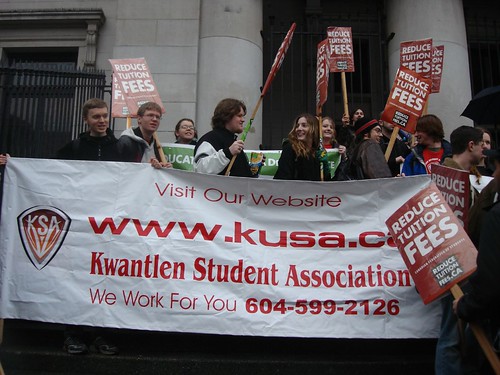
National Day of Action 2007

(That me on the left!)


The rally and impromptu march in Vancouver, though smaller than in 2004, still managed to produce quite a strong response. Our march through the streets of downtown Vancouver only covered half of the road; cars still ran on the other half, and many of them honked in support of us. The student press covered the National Day of Action very comprehensively (Langara, Lakehead, Concordia, etc.) and the mainstream media also took notice.

However, I think that the simple message "Students wants tuition fees reduced" won't really resonate if the pundits like Ian King respond by stating "Yeah, but it's a bad idea." King's stance - that the government should increase the provincial grant program - was actually stated in the speeches that preceded the march, but this was drowned out in the storm of "Reduce Tuition Fees" posters.

Labels: ,

Friday, December 15, 2006

CFS-BC job opportunity: apply by Dec. 19 or 29

The Canadian Federation of Students - British Columbia Component (CFS-BC) has posted an employment opportunity for a Research and Communications Officer for a six-month term, starting January 2007. However, there are two different versions of this notice floating around, each indicating a different application deadline.

The notice on CharityVillage.com ("Canada's supersite for the non-profit sector"), which was posted on December 14, indicates that the deadline for applications is December 29, 2006, giving applicants 14 days to submit their résumés. In contrast, the PDF document that was emailed to all CFS member local associations in BC, also sent on December 14, states that the deadline for applications is December 19, 2006, giving applicants just 5 days (including the weekend) to submit their résumés. In addition, there are a number of small discrepancies between the CharityVillage version and the PDF version of the job. (For example, the CharityVillage version indicates that knowledge of Adobe Illustrator, IWork '06, Adobe Creative Suite 2 and Filemaker Pro is important, software that is not mentioned in the PDF document.)

Labels:

Tuesday, December 05, 2006

SFSS By-Election: The Candidates

A by-election is taking place to replace the "Group of Seven" on the Simon Fraser Student Society Board of Directors - and as far as I can tell, most SFU students don't have a clue that this is taking place! The Independent Electoral Commission helpfully informs us that voting will take place on December 18 and 19 - after final exams are all finished - and that "advance polling" will take place on December 7, 8, 12, and 15.

And what of the candidates in this by-election? No doubt many of them will be putting up glossy posters of themselves in the next few days, but this reveals little, if anything, about the candidates themselves. Fortunately, thanks to Facebook, Google, and my own knowledge of matters political at SFU, here is a brief précis of the hacks and hacks wannabe:

(1) President
(2) External Relations Officer
(3) Internal Relations Officer
(4) Member Services Officer
  • Pretty much all that I know about MSO candidate Matthew De Marchi is his persistent opposition to the impeachment of the "Group of 7." According to the Special General Meeting minutes [PDF], Mr. De Marchi questioned the appointment of Chair Patrice Pratt; questioned the legitimacy of the Forum meeting which had called the SGM; and attempted to have the SGM consider the By-Law amendments after the impeachment motions. He wrote a letter to The Peak prior to the SGM, questioning the entire basis for impeaching the "Group of 7." After his efforts to prevent the impeachment failed, Mr. De Marchi called the SGM "A good ol'-fashion' lynchin'," "an incredible 'circle jerk,'" and a "Nuremburg Rally." He also criticized the security volunteers as "arm-banded brownshirts." Interestingly enough, one of these "brownshirts" is none-other than candidate for Internal Relations Officer Sean Magee....
  • Chris Sandve ran for University Relations Officer with Orange Revolution in the Spring 2006 elections, finishing third (behind me). In November of this year, he was elected President of the BC Young Liberals (province-wide). His Facebook entry also shows him to be a supporter of the Conservative Party of Canada.
  • Bryson Yuzyk ran for Member Services Officer in the spring 2005 elections, with the DoublePlusGood slate (along with Graham Fox), losing to Common Sense candidate Shawn Hunsdale.
(5) Treasurer
(6) At-Large Representative
  • I have no information on Derek Andrew.
  • Niusha Bakhtiari would be the perfect "Manchurian Candidate" - there is virtually nothing available on the Internet about her. Except one. The minutes [PDF] of the September 15, 2006 meeting of the SFSS Board of Directors show that then President Shawn Hunsdale nominated Ms. Bakhtiari nominated her, successfully, to sit on the Stipend Appeals Committee, which handles appeals from directors and Forum members over stipend deductions.
  • Jacqueline Hiew is the Vice-Chair of the History Student Union. She served as Forum Rep from July 19 to September 22, 2006, and ended up being at the centre of a legal dispute over the legitimacy of the September 27 Forum [PDF] meeting.
  • There are plenty of Google hits on Karilyn Kempton, but I have no idea whether they are referring to the candidate in these elections.
  • Tyler Massé is a member of the Executive of the Geography Student Union.
  • Ashley Nijjer's primary accomplishment to date appears to be her incendiary letter to the editor of The Peak, alleging that former President Clement Abas Appak had impure motives in pushing for the impeachment of the Group of 7, due to his affiliation with Canadian Students for Darfur. (This letter was rebutted in a subsequent letter to The Peak by Mr. Apaak.)
  • Joseph Paling has written quite a number of articles to The Peak over the years.
  • I have no information on Serenna Romanycia.
So that's that! SFU students: find out all the information that you can about the candidates, and please take the time to vote!

Non-SFU students: again, my apologies for the SFU-centric nature of this blog. As soon as the by-election - and my final exams (!) - are over, I will again have enough time to offer a more pan-Canadian perspective on this blog.

Labels: ,

Saturday, November 18, 2006

Global News Continuing Coverage of the Douglas Students' Union

Joey Coleman reports on the latest Global news coverage of the Douglas Students' Union.

A very interesting story, to say the least.

The report states that Philip Link, who apparently approved the $276,000 loan from CFS-Services to the Douglas Students' Union, simply "works" for CFS-Services. In fact, according to news reports on the Travel CUTS lawsuit settlement, Mr. Link is the Executive Director of CFS-Services. This is a very substantial responsibility.

Now, I had known from reading articles in The Peak that Mr. Link had a colourful past, but it had been my impression that his only formal altercation with the law came with his 1997 acquittal of assault charges against Lana Many-Grey-Horses (whose testimony regarding the above you can read in these Langara Students' Union old minutes). So the Global news report is a new revelation for me.

In any event, I am now seriously considering re-posting the Douglas Students' Union forensic audit on my website. The post-audit memorandum is disconcerting in and of itself, but this is nothing compared to the forensic audit. When I last posted this forensic audit, Joey Hansen's lawyer gave me a letter threatening to sue me unless I took it down. At the time, I assumed that he had to have some sort of solid legal ground. But now that mainstream media companies like Global TV are prepared to talk about the contents of this forensic audit, this seems more like "SLAPP-like" behaviour to me....

Labels: ,

Sunday, October 29, 2006

Andrea Sandau, the University Relations Officer of the Simon Fraser Student Society, has written the following affidavit:

Statement of Andrea Sandau

University Relations Officer, Simon Fraser Student Society (SFSS)

On Tuesday June 6, 2006 in the early afternoon, between approximately 2:00pm-4:00pm, I spoke with Ms. Margo Dunnet in the Board of Directors office of the Simon Fraser Student Society (SFSS) (MBC 2220) regarding one of the SFSS’s employees, Ms. Hattie Aitken, the Graduate Issues and University Relations Coordinator.

In that conversation, prior to the commencement of an investigation that led to Ms. Aitken’s firing, Ms. Dunnet informed me that the SFSS was planning to fire Ms. Aitken. I did not realize it at the time, but it would soon become clear that the investigation was launched specifically for the purpose of generating the justification for her termination. I believe this decision to fire Ms. Aitken was already made prior to the discovery of the evidence upon which her firing was allegedly based.

During that conversation, on that June afternoon, I stated that I had to schedule a meeting with Ms. Aitken within the next few days, before I was to leave for Europe. I did not know Ms. Aitken well, so I asked Ms. Dunnet for suggestions about how to interact with Ms. Aitken. Ms. Dunnet responded, “You won’t have to worry about her when you get back anyway.” I asked Ms. Dunnet, “Why, are you guys gonna’ fire her?” Ms. Dunnet smiled and nodded. She replied: “Yeah, we’re looking at letting her go. We don’t trust her. She attempted to bring speculation upon the Canadian Federation of Students (CFS) at the CFS conference in May by publicly asking inappropriate questions during some of the meetings, and she missed most of the workshops she was supposed to attend.” I asked some questions about the CFS conference, but I asked no further questions about this employment issue.

At the time that Ms. Dunnet shared this information with me, we shared a positive working relationship, having recently run on the same political slate, “Common Sense.”

I shall post a scanned copy of this affidavit when it becomes available.

Labels: ,

Wednesday, October 04, 2006

University of Saskatchewan Students' Union By-Election

The University of Saskatchewan Students' Union is having a by-election to replace their former President, Evan Cole. Mr. Cole resigned under pressure from the other members of the USSU Executive due to his decision to write an affadavit in a lawsuit filed against the USSU surrounding the referendum on joining the Canadian Federation of Students. Speaking of said lawsuit, I have obtained the court documents that have been filed by the various parties:

Labels: ,

Friday, September 22, 2006

Interesting Videos on YouTube...

Labels: ,

An Update on SFU Health Plan Politics

StudentUnion.ca has learned that several directors of the Simon Fraser Student Society are doing classroom speaking, explaining to students that they are trying to bring then a "non profit undergraduate health care plan." There is only one such plan in Canada: the National Student Health Network. The Board of Directors has never decided to limit their health plan choices to non profit entities, nor has any such decision been made by an entity acting under delegated authority.

Labels: ,

Wednesday, September 20, 2006

SFSS Hires Catalyst Creative to Survey SFU Students re: Undergraduate Health Plan

Undergraduate students of Simon Fraser University are some of the last remaining university students in Canada not to have a student health plan. Starting in 2005, SFU graduate students obtained a health and dental plan following a student referendum, through Gallivan and Associates. And so, this past summer the Simon Fraser Student Society formed an "Undergrad Health Plan Negotiating Committee" to look into the possibility of obtaining a health plan for undergraduate students.

Interestingly enough, however, the Executive Committee of the SFSS just today approved a motion assigning to Catalyst Creative, Inc. the task of conducting a survey of SFU undergraduate students relating to a possible health plan. [Note: See update below for correction.]

Now Catalyst Creative is an interesting firm. Their Vice-President (also known as the "Strategic Director") is none other than Michael Gardiner, who also works (or at least was recently employed) as Organiser of the Canadian Federation of Students-BC. This article (PDF, p. 8), published by CCEC Credit Union, indicates that Catalyst Creative was founded in 2005 by just two individuals: Michael Gardiner and David Launainen.

Catalyst Creative's website does not indicate that they have any expertise conducting surveys or soliciting opinion. Their services (according to their webstie) are Merchandising, Print Media, Broadcast Media, Publicity and Earned Media, Events, Training, Positioning, Identity, Packaging, Web Technologies, e-Collateral, and Print Collateral. Their list of clients is interesting, however, as it includes the National Student Health Network (NSHN), owned and operated by the Canadian Federation of Students-Services. And, indeed, CIRA records show that the Administrative Contact for the NSHN is none other than Michael Gardiner.

SFSS records also indicate that the Catalyst Creative staffer responsible for conducting the survey is the same Mr. Gardiner. External Relations Officer Margo Dunnet's August work report states:
"The Undergrad Health Plan Negotiating Committee met with Michael Gardiner from Catalyst Creative to discuss what should be included in the survey to undergraduates. We mapped out the questions and he will get back to us with the format in early Sept. I talked to Ron Heath, Office of the Registrar, and he agreed to supply us with the e-mail addresses we need to administer the survey."
SFSS executives may wish to consider a historical perspective in this matter. In an article written in 1996 entitled "SFSS, This is Your Life," Peak writer Patrick Kolby wrote:

After the summer hiatus, Forum members decided to begin steps to hold a referendum on SFSS membership in CFS. The move was sparked by problems with the CFS' handling of SFU's health care plan broker, and an apparent conflict of interest between the plan's organizer, Joey Hansen, and the CFS. Hansen held positions both on the SFSS and on the CFS. Although not a concern of most students, the SFSS dissatisfaction with the CFS grew as they were blamed for the problems of the health plan. Adding to the push to leave the CFS was the creation of a new student organization, the Canadian Alliance of Student Associations. This new option has made the move possible for SFU out of the CFS and into CASA more likely than ever. How the implementation of the CFS-backed health care plan in May affects the proposed referendum is anyone's guess. It is also anyone's guess whether or not the plan will actually be implemented by May, if the past is any indication. In their final act of 1995, Forum voted to decide to consider one of the many options to increase efficiency after the $25,000 Ernst & Young accounting report was tabled. Good work.

Another article in 1997, entitled "Students axe health plan," provide a short summary of what happened to our previous health plan:
Although Simon Fraser students decided to remain in the Canadian Federation of Students in last week's referendum, they axed the federation's health plan.
....
The plan, implemented in January of this year, was the target of attack from a number of extremely vocal groups on campus. Aspects under fire included the inability of students with only basic provincial health care to opt-out, as well as concerns that the CFS was receiving a large commission from student fees.
....
Respresentatives of the federation deny allegations that it is profiting from the National Student Health Network.
"It's a break-even operation," said Michael Gardiner, provincial chair of the Federation. "The only reason the CFS operates the health plan is so that individual student associations don't get ripped off by local brokers. The National Student Health Network has brought prices down for everyone. Because of this, students across the country get their health care cheaper."
(The aforementioned Margo Dunnet is a member of the Executive Commitee of the Canadian Federation of Students - British Columbia.)
..............
UPDATE (2006-09-23): I have been informed that the Executive Committee of the SFSS merely received a report from the Undergrad Health Plan Negotiating Committee regarding the retention of Catalyst Creative; it did not actually pass any motion. The Undergrad Health Plan Negotiating Committee was struck by the Board of Directors on July 27, with a mandate to spend up to $6000 on a contractor to create a survey for the undergraduate health plan.

Labels: ,

Wednesday, September 06, 2006

Wednesday, August 23, 2006

CFS-Quebec Creates New Confusing Website

The Quebec component of the Canadian Federation of Students has created a new website, www.cfs-fcee.qc.ca. This replaces their old website, www.education-action.net.

However, a great deal of confusion remains. Their old website, www.education-action.net, has not been updated to redirect people to the new website. A great deal of content on the old website has not been transferred to the new site (such as issues of Ruckus magazine, published by CFS-Quebec).

One will also find contradictatory press releases. "CAPE [Coalition for Accessible and Public Education] is a province wide coalition that includes the Canadian Federation of Students (Québec), the Conseil Régional de l'ASSE à Montréal and the Front Régional des Associations étudiantes de la Capitale amongst other groups" proclaims one press release dated March 22, 2006; seven days later, another press release states: "The CFS-Québec is not a part of the coalition that is organizing the demonstration, the Coalition for Accessible Public Education (CAPE)." There was no "apology" or "retraction" issued for the earlier press release - simply a contradiction.

One possible explanation for the errors in the "new and improved" CFS-Q website may lie in its administrators. According to CIRA, the "Administrative Contact" for cfs-fcee.qc.ca is Joey Hansen (who is erroneously listed as the Treasurer of the Canadian Federation of Students) while the "Technical Contact" is Ken Marciniec. Mr. Hansen is presently the Services Coordinator of the Douglas Students' Union - in British Columbia! - while Ken Marciniec is the National Executive Representative for CFS-Ontario. Mr. Marciniec administers, on behalf of the Canadian Federation of Students, the domain www.casa-acae.ca, which just happens to be the bilingual domain name of CASA (as The Paulinian has documented). He also administers, on behalf of CFS-Ontario (!), the "new and improved" website of the University of Toronto Students' Administrative Council.

Labels: ,

Tuesday, August 01, 2006

Great Moments in Human Resources Management

The Simon Fraser Student Society (SFSS) ordered seven key staffers to go on paid leave last Wednesday, pending an "investigation", the details of which are as yet unknown to the general student population. However, it is known that the Graduate Issues and University Relations Coordinator and the Graduate Benefit Plan Coordinator are being subjected to interrogations today. SFSS executives aren't talking to the press or to the general public, but the evidence points towards an attempt to leave the SFSS Graduate Health and Dental Plan with Gallivan and Associates, and possibly to join the CFS National Student Health Network.

Fortunately, The Peak has been covering this issue in great detail:

There is very little that I can add at the present time to what The Peak has covered - in either news or commentary. However, The Peak did leave out one important facet of this story. Both Financial Coordinators have been placed on leave, leaving the Society's Finance Office empty. However, the Society has not been shut down. This raises an important question: who is doing the accounting? Are the SFSS executives trying to do the accounting? Or are they just spending money without keeping track of what they are spending?

.............
UPDATE (2006-08-03): I can now answer the questions that I asked. I have been informed that the Society's auditors (who are qualified accountants) did some of the cheque writing for some of the Society's employees. Furthermore, both Financial Coordinators are now back at work.

Labels: ,

Friday, July 28, 2006

Council of the Federation

Here is the news that I have found regarding the recent meeting of the Council of the Federation and post-secondary education:

Labels: , ,

Tuesday, July 25, 2006

Blogroll Added

I just did what I ought to have done months ago - added a blogroll! Thus far, it's kind of small. So if you're a student politician, a student journalist, or are otherwise in any way interested in student unions, post-secondary education, student journalism, etc., and you maintain a blog that touches - if only sometimes - on such subjects, then please email me and I'll you!

Also, in an unrelated matter: I blogged earlier on a press release from Lakehead University and Lakehead University Student Union (LUSU) concerning tuition fee increases at that university. LUSU has since issued a press release with the title "Lakehead University Student Union Stands in Solidarity with the Canadian Federation of Students." Seeking to "clarify" its earlier joint press release, LUSU reaffirmed its "alliance" with the Federation and noted that while they continued to believe that "Lakehead University is doing the best job it can under this difficult provincial regulation," LUSU nonetheless supported the Federation's goals of "lowered tuition fees." This press release also questioned the use of the term "market value" to characterize tuition fees, even though this term was used in their original joint press release.

Labels: ,

Canada's student financial aid system in 'crisis' by 2010: think tank

The Canadian branch of the Educational Policy Institute (EPI) has released a new report, entitled "Student Aid Time Bomb: The Coming Crisis in Canada’s Financial Aid System" (PDF document). The report claims that by 2010, Canada's student financial aid system may be underfunded by as much as $800 million. The report suggests that there are four pressures being placed on the system:
  1. By increasingly devoting funds towards the subsidization of advanced education without targetting those funds to low-income students, governments (both federal and provincial) are left without money to put towards means-tested financial aid. This sort of subsidization includes direct government subsidization of the costs of education; tuition tax credits; and the subsidization of individual savings (i.e. the Canada Education Savings Grant).
  2. The Canada Student Loans Program (CSLP) is increasing its costs dramatically due to increasing student demand and increasing interest rates, but there does not appear to be much political will to increase funding for the program.
  3. The Canadian Millenium Scholarship Foundation (CMSF) is due to 'expire' in 2009, and political pressures may mean that this foundation might not be renewed.
  4. The Conservative government, due to its 'open federalism' (re: means of gaining the support of the Bloc Quebecois), may be transferring responsability for student financial aid to the provinces. The report does not disparage this idea in principle, but warns that such an upheaval would be a "distraction" from the real issue: the need to increase student financial aid funding.
Sifted into the report one will find jabs directed (primarily) against the Canadian Federation of Students. In the report's commentary on the "distraction" that would be caused by transferring responsibility for student financial aid to the provinces, it is suggested that much of the opposition to such a move on the part of national post-secondary student organizations would be pure self-preservation: "[CFS and CASA] would be left with precious little to do if student aid policy were decisively dispersed to the ten provincial capitals" (p. 28). More bluntly, the report complains that provincial intiatives to freeze or regulation tuition fees came due to their decision to heed "the ill-conceived and transparently self-interested advice of student groups" (p. 12).

The CFS responded with a press release declaring that the report was "misleading," that it "distort[ed] the legitimate pressures placed on Canada's student financial aid system to justify tuition fee increases," and that was intended to influence the upcoming meeting of the Council of the Federation. "This isn’t research. This is a public relations campaign against affordable public education," said Amanda Aziz, National Chairperson of the Canadian Federation of Students. CASA had no response (on its website, at least).

All this in spite of the fact that the CFS and the EPI report actually agree on a number of issues. First, "Student Aid Time Bomb" (p. 12) and the CFS both question the merits of the Canada Education Savings Grant. Second, "Student Aid Time Bomb" (p. 17-18 et al.) and the CFS both agree that tuition tax credits are a poor way of expanding access to post-secondary education. Third, the primary argument of "Student Aid Time Bomb" - that Canada's student financial aid system needs more money in order to assist low-income students effectively - is one that the Federation would likely readily agree to.

That said, there are clear ideological differences at play here. "Student Aid Time Bomb" describes the trend towards tuition fee regulation, tuition tax credits, and other non-means-tested subsidizations of students' education as "Sleepwalking Towards Universality" - "universality" being held in a rather dim light.

But ideological differences are not the only reasons for this quarrel. One of the author's of the EPI report is Alex Usher, Vice-President of EPI and the original National Director of the Canadian Alliance of Student Associations (CASA). He has also written for EPI "Much Ado About a Very Small Idea" (PDF), concerning Income-Continent Loan Repayment schemes. This report was throughly savaged by then-CFS National Director of Research (and current CAUT employee) Michael Conlon in his report, "Income Contingent Loans: Inequity and Injustice on the Installment Plan" (PDF). Conlon devoted an entire three-paragraph footnote (p. 12, footnote 10) detailing Usher's involvement in CASA and suggesting that Usher and CASA were formed as pawns of the Canadian Liberal government. In particular, Conlon claims that Lloyd Axworthy (then Human Resources and Social Development minister) sought to undermine the CFS by establishing "an unrepresentative minority voice opposing the Canadian Federation of Students' call for lower tuition fees and a national system of grants." Axworthy currently sits on the Board of Directors of the Educational Policy Institute.

Personally, I agree with the proposal of Spencer Keys (PDF) that governments should agree to set student tuition fees as a set percentage of the total cost of a student's post-secondary education, and then allowing fees to rise (or fall) provided that government funding also rises (or falls) proportionately. I also believe that it is important for our various lobbyists to present a united front on those issues where there is a strong policy consensus: that the Canada Educational Savings Grant should probably be scrapped (or at least seriously reformed), that tuition tax credits are a bad idea, and that there is a very substantial need to overhaul and renew the financial aid system.
..........
UPDATE (2006-07-25): The Canadian Alliance of Student Associations (CASA) has issued a press release in response to "Student Aid Time Bomb", essentially agreeing with the Federation's press release but using softer language and placing a greater emphasis on the need for more direct institutional funding.

Labels: ,

Thursday, July 20, 2006

Update on Evan Cole Resignation

Joey Coleman has obtained the following resignation letter from Evan Cole, ex-President of the University of Saskatchewan Students' Union:


Labels: ,

Wednesday, July 19, 2006

Evan Cole Resigns from USSU Under Pressure

Joey Coleman reports that Evan Cole, recently elected President of the University of Saskatchewan Students' Union, has resigned, following a narrow decision of USSU Council to call for his impeachment from office.

I blogged on the controversies surrounding the USSU referendum on joining the Canadian Federation of Students in May 2006. Evan Cole, then a Vice-President of the USSU, had campaigned against joining the Federation at the time.

Labels: ,

Saturday, July 08, 2006

CFS and CFS-Services Bylaws, Policies, and Annual Reports, 1981-Present, Now Posted

In accordance with federal law, non-profit corporations under the Canada Corporations Act are required to file all amendments to their Bylaws with Corporations Canada. In addition, they are required to file an Annual Report every year, detailing the membership of their Board of Directors. These documents may then be retrieved by interested citizens for a modest fee. And so, this interested citizen has retrieved all the documents of the Canadian Federation of Students and of the Canadian Federation of Students-Services from Corporations Canada. They are now available online here. A link to this page has also been established on my main CFS information page.

Unfortunately, I was not able to compile a full list of Federation executives, for two reasons: first, the Federation didn't bother to submit that many Annual Reports (especially for CFS-Services); and second, many of the old Annual Reports that were submitted frequently did not list the names of the representatives from the provinces (as they were required to do). (Since 2004, however, both CFS and CFS-Services have been completely compliant with respect to both Annual Reports and [to my knowledge] Bylaws and Standing Resolution amendments, thanks to the diligence of Internal Coordinator Lucy Watson.)

The historical bylaws, policies, and reports of the Federation are extremely fascinating. We find, for example, that the original bylaws of the Federation conceived of an organization that would not operate in Quebec. Instead, the "organized post-secondary students in Quebec" would elect a non-voting observer to the Central Committee of the Federation (later called the National Executive). It was only in 1987 that the Federation voted to establish a voting provincial representative on the National Executive from Quebec.

We also find that the bylaws of CFS-Services were once quite distinct from those of the CFS. The original bylaws of CFS-Services stipulated that the Board of Directors of CFS-Services would consist of nine provincial representatives (again, excluding Quebec), one representative of the Federation, and the Executive Director of CFS-Services as an ex-officio, non-voting member. This Executive Director was one David Jones, who appears to have served from 1982 until sometime in the mid-nineties. (Anyone know what happened to him?)

The names listed in these documents are also interesting. We find that one Diane Flaherty was an early Executive Officer of the Federation (an office since disestablished) - and, indeed, Ubyssey archives show her as such (here, here, and here). The National Chairperson of 1993 - Kelly Lamrock - is presently a Liberal MLA in the Legislative Assembly of New Brunswick!

Having a look at these bylaws has also raised some interesting questions in my mind:
  • Have a good look at CFS Bylaw 1, section 2.a-vi. Remember that the Bylaws of the CFS and of CFS-Services are identical - as such, member local associations owe a $3.75/student fee to both the CFS and to CFS-Services! Technically speaking, doesn't this mean that all member associations have been delinquent in paying their fees to CFS-Services for many, many years now? And technically speaking, doesn't this mean, as per Bylaw 1, section 3.b-i, that no student associations are allowed to cast a vote at meetings of CFS-Services? Thus - unless the National Executive of CFS-Services have granted an exemption "on a case-by-case basis" to all member local student associations for the past several years - it would appear that all votes done at Federation meetings that purported to affect CFS-Services are, technically speaking, null and void.

  • Take another look at CFS Bylaw 1, section 2.a-vi and 2.a-vii. Now check out this definition of "notwithstanding" in Duhaime's Canadian Law Dictionary. (This is also the only definition that makes sense when interpreting s. 33 of the Canadian Charter of Rights and Freedoms.) Technically speaking, does this not mean that the fee continues to be $3.00 per student? (Incidentally, this sort of mixup is not limited to the Federation; the Bylaws of the Kwantlen Student Association, specifically Article 3, clause 4 (v), technically require the organization to break its own bylaws as well as provincial law in order to consider special resolutions, due to a confusion between the meaning of the words "proscribe" and "prescribe.")
Anyways, have fun looking at these bylaws, discovering when certain bylaw provisions were added or deleted, and finding out what CFS alumni are up to these days! I, for one, will be in Sechelt, BC, on vacation until July 16, 2006. As Internet access will be very limited, this weblog will not be updated until then.

[Disclaimers: [1] I am not a lawyer; this is not legal advice; use at your own risk. [2] The absence of certain documents on my website (such as certain Annual Reports) may not necessarily be due to a lack of compliance on the part of the Federation; it may also be a clerical error on the part of Corporations Canada, or (hopefully not!) of myself.]

Labels: ,

Wednesday, June 28, 2006

Tuition Dispute

But this time, the university administration and the students' union are on the same side.

A recent press release from CFS Ontario claimed that a number of universities in Ontario were poised to raise tuition fees well above the 5% limit set by the provincial government in March 2006. Among the universities cited were the University of Toronto, Ryerson University, and Lakehead University.

However, in a joint press release issued by the Lakehead University Students' Union (CFS Local 32) and Lakehead University, the Presidents of Lakehead and of it's Students' Union refuted this claim. They said that Lakehead was only planning increases in the range of 3.9% to 4.5%, "well below the 5% average cap established by the McGuinty government." The issue has also come to the attention of the local media.

......
UPDATE (2006-07-25):
LUSU has since issued a press release with the title "Lakehead University Student Union Stands in Solidarity with the Canadian Federation of Students." Seeking to "clarify" its earlier joint press release, LUSU reaffirmed its "alliance" with the Federation and noted that while they continued to believe that "Lakehead University is doing the best job it can under this difficult provincial regulation," LUSU nonetheless supported the Federation's goals of "lowered tuition fees." This press release also questioned the use of the term "market value" to characterize tuition fees, even though this term was used in their original joint press release.

Labels: ,

Wednesday, June 21, 2006

Questions of Affiliation

I had a look through the websites of the various national and provincial organizations that represent students' unions' (and presumably, students') collective voices to government. And what interesting things one can find! Here are just a few gems:
..................
UPDATE (2006-06-26):
  • I have been informed that the ASU actually is a member of ANSSA, notwithstanding its (apparent) reluctance to claim such affiliation on its webpage devoted to telling people which organizations it is a part of....
  • The DAGS (Dalhousie Association of Graduate Studies) executive appears nonplussed to the idea of being a member of either GSAC or the CFS. They officially requested that their prospective membership in the CFS be "dissolved" in April 2005, and they voted to withdraw from GSAC in January 2006. More recently, the 2005-2006 exit report of the outgoing Vice-President External recommends that DAGS not join either organization - GSAC due to its limited profile and lack of communication, and CFS due to "strong ideological differences with their policies." However, the same report also encouraged developing a "positive open relationship" with the Federation's National Graduate Caucus, and encouraged a stronger push for graduate student representation within CASA.
  • As has been noted in the comments, the College Student Alliance's double-counting of members is a web site error.

Labels: ,

Tuesday, June 13, 2006

Purely Factual News

In purely factual news:
  • Amanda Aziz is the National Chairperson-elect of the Canadian Federation of Students. Unless the bylaws have been changed, her term technically began at the close of the 2006 Semi-Annual General Meeting (i.e. on May 28), but the CFS web site has not yet been updated to reflect that fact
  • Penny Beames' struggle to win a second term as Chairperson of the University of Victoria Students' Society (UVSS) has succeeded. At the May 4, 2006 meeting of the Board, the following motion was passed:

    "WHEREAS the appeal process involving Mike Waters and Penny Beames has already cost the society thousands of dollars; and
    WHEREAS Mike Waters has requested that no further action be taken on this matter so as to prevent further losses to the Society; therefore
    BIRT although the Board finds highly suspect the conduct of the previous Board in regards to the disqualification of Mike Waters, this Board does not wish to pursue the issue any further."

    Ms. Beames is now in charge of the UVSS - notwithstanding the fact that a majority of the members of its Board of Directors were part of an opposing slate, the fact that that slate's candidate for Chairperson received more votes than her before being disqualified, and the fact that the Board of Directors officially considers "highly suspect" the process that lead to Ms. Beames' acquisition of the Chairpersonship for 2006/07. All of which leads to the inevitable question: how will the UVSS survive this year?

Labels: ,

Thursday, June 01, 2006

Canadian University Press Threatens to Incinerate 'Annoying' Student Associations

Are you a student politician? And is the student press on your campus independent of your student association? If 'yes', then you may very well have come in for a lot of criticism from your local campus media. The student press in Canada is very famous for asserting its independence, and for insisting on ruthlessly reporting on the shenanigans of on-campus organizations, including student associations.

The intentions of the student press, however, may have taken a darker turn. To cite a resolution that was passed in January 2005 by Canadian University Press, the alliance of Canadian student newspapers:
WHEREAS once upon a time, CUP had an awesome idea of building a Death Star, and decided to put money toward making it happen, and
WHEREAS student unions are evil and should be eliminated from the galaxy (toasted like flaming marshmallows), and
WHEREAS we have serious engineers who support the idea and are willing to work pro bono on this project, and
WHEREAS late during plenary at CUP 66, some people put forward a motion to loot the Death Star Fund in order to build a houseboat, and
WHEREAS a houseboat seems silly and unrealistic, like much of what comes out of the Gateway, and
WHEREAS a Death Star would still totally rock!

BIRT CUP change the houseboat fund back into the Death Star Fund, and
BIFRT the fund continue to be contributed to at the rate of $π ($3.14) per year, until such time that funding is sufficient to research, design and build a full-scale Death Star to be used as a negotiating tool for CUP members with student associations and university administrations, and
BIFRT CASA and CFS are nerdy geeks, and
BIFRT the Death Star also be used to acquire revenge on student associations or other unpleasant groups of individuals who annoy anyone in CUP, for any reason, and
BIFRT the Death Star be used to extort money from large multinational corporations, where such activity is not against the law, and
BIFRT we acknowledge that the Death Star is very important to many members of CUP, and therefore not try to replace it with any other vessel or vehicle of destruction.
So... are the nerdy geeks in charge of your student union capable of piloting X-Wing fighters?

(This motion, and many other of a similarly hilarious nature, were discovered on the weblog of local SFU campus media baroness Amanda McCuaig.)

Labels: ,

Saturday, May 20, 2006

The Smoking Gun

Click to download: Gavin Gardiner's Notebook [PDF]

Odds are, most readers of this blog are not familiar with the great controversies that surrounding the University of Saskatchewan Students' Union over the past year. Briefly stated, the organization applied for prospective membership in the Canadian Federation of Students in November 2004; they postponed their referendum after receiving legal advice that such a referendum would violate USSU bylaws; they attempted to merge USSU and CFS policies [PDF] by ordering the results of the referendum subject to the ruling of the USSU Elections Board; students voted 55% in favour of joining the CFS; the Elections Board overturned the referendum, citing numberous problems; and most recently, USSU Council ignored the decision of their Elections Board and accepted membership in the CFS.

And in the process, it was discovered that a number of pages of President Gavin Gardiner's notebook had been taken, scanned, and distributed to the public at large. This was noted in The Sheaf, and at a meeting [PDF] of the USSU Students' Council. Furthermore, the debate noted in the minutes of that meeting goes a long way towards establishing the authenticity and reliability of the document in question:
"Member Mowat stated that everyone probably received the email from the unknown source that had a bunch of information from President Gardiner’s book.

Chair Thoma asked President Gardiner to clarify this issue for people who did not receive the email or read the Sheaf.

Member Mowat stated he brought this up because of the article in the Sheaf and one of the councilors said to ignore this. I would like some clarification on some of the goals in President’ Gardiner’s stolen notebook. What kind of meeting was this? Was there a meeting at all? What do some of these comments meetings mean? I understand that there is a referendum here to join CFS but I am concerned that student money is going towards a goal to get UBC out of CASA to switch our health plan. President Gardiner stated that in the paper some of these goals were forged, and some were real, he didn’t want to go into this because it was personal. I am uncomfortable as a student paying his salary to spend time doing some of these activities, if he was at all. I would like an explanation.

Councilor Mitchell stated she does not want President Gardiner to have to defend himself right now. I don’t think this is appropriate considering it is under criminal investigation about how this information was obtained. It is offensive that our intelligence is being questioned as councilors. I would encourage President Gardiner not respond unless he chooses to.

President Gardiner stated he is going to stay away from the specifics. If Member Mowat wants to talk to me one on one I will do that. The fact at hand remains that my notebook and I have written lots of things down that are not necessarily my own opinion. A lot of this was taken completely out of context and I don’t think it is appropriate for me to explain a stolen notebook at a public forum.

Member Forbes asked if this Planning Session went ahead?

President Gardiner stated he was at a meeting and there were MSCs and lots of other people there besides me."
Please note that Mr. Gardiner never disputed the authenticity of the document in question. Further, please note that Mr. Gardiner's 'defense' consisted of his stating that many of the notes recorded in the notebook were not his "own opinion." In stating this defense, he implicitly admitted that they were, nonetheless, things that were discussed - by someone, at least.

So what's in the notebook? Here are some relevant extracts:
* NSHN talk to Tom
* GSA, USSU & URSU Health Plan Policy
* internal McGill levy
* time line for McGill
* Dastageer [sic] about Phil Ollete [sic]
*
meeting w Don Rossick
* CAUT referendum
* Meshon and website
* Control voter turnout + demographics
...
Planning Session July 25/05

2004/05 Goal Review

1) Prospective by November
2) Full membership by May
3) Electing good slates for 05/06
4) Withdrawing from CASA
5) Stopping other members from joining
6) Purging bad staff
7) Replacing w good staff - CFS
8) Getting local 10 back
9) Getting UBC out of CASA / GM
10) Getting U of M and U of R out of Campus Advantage
11) Getting everyone out of Amiccus
12) Use CCSA to our advantage
13) Long term CUTS lease
14) Switching health plans & laying ground
15) Stoping [sic] Buckmank's [sic] expansion into SIAST
16) Phones for students
17) Shit from 03/04
18) Undermine Council

2005/06 Goals

1) USSU Website
2) Health Plan
3) Handbook
4) Elections
5) AMICCUS-C
6) McGill
7) Staff

......

* Get Premier to mention CFS

U of S referendum dates
Campaigning begins Sept 19
Voting
....
Education
1) Resign outright
2) Resign & S.A.C.
3) Stick it out until end of Sept.
4) Ignore
...
Staff
* Student hiring committee (talk to UMSU)
* develop list
* get out bad staff

Get Evan to resign? Angela - 613-612-4780
(Links and emphasis added.)

Very interesting, no? The goal "Use CCSA to our advantage" has certainly been corroborated by previous posts on this blog, but what about the other goals? And is there any evidence that similar strategies have been in place at other students' unions?

Also, what is this about McGill? Are they referring to the Post-Graduate Student Society of McGill, or the (undergraduate) Student Society of Mcgill University? And what sort of "internal levy" are they planning?

Labels: , ,

Wednesday, May 17, 2006

All Your Conference Are Belong To Us

In previous posts, I noted how the Canadian Congress of Student Associations and it's various sub-conferences (SuperCon, MoneyCon, and Canadian Academic Roundtable) had been incorporated as Canadian not-for-profit corporations - with a leadership that just coincidentally happened to consist mostly of Canadian Federation of Students executives. All this was thanks to the good people working for the Government of Canada, who had published such information on their webpage. But as it turns out, this is hardly the only information kept by the government. The Letters Patent, Bylaws, and Annual Reports for all not-for-profit corporations are kept on file, just ready for bloggers like myself to obtain them and publish them for all to see:
CCSA and SuperCon do not have Annual Reports because they are too young, only having been incorporated in August 2005. In contrast, MoneyCon and Canadian Academic Roundtable have been incorporated long enough to have sent in an Annual Report - and to have changed their Board of Directors. Fortunately, the Letters Patent of these corporations clearly tell us who were the original directors of these two corporations.

The original directors of MoneyCon were:
  • Amanda Aziz (who has been described earlier in another post)
  • George Soule, National Chairperson of the Canadian Federation of Students. Mr. Soule is the former VP Finance of the Carleton University Students' Association.
  • Jesse Greener, Ontario Chairperson of the Canadian Federation of Students. Mr. Greener is the former VP External of the Society of Graduate Students of the University of Western Ontario.
And the original directors of the Canadian Academic Roundtable were:
Also of interest are the bylaws themselves. Considering that the CCSA conference coordinator, Adrienne de la Rosa, has appealed to potential conference-goers in the name of "democracy," one would - logically - assume that these bylaws would be the very epitome of democracy, yes?

Wrong. These bylaws are anything but democratic.

The membership of the CCSA, according to its bylaws, consists of students (note: not student associations) who have applied for membership, and whose application "has received the approval of the Board of Directors" (Bylaw 3.1). There is no obligation on the Board to accept, or not accept, any one application, nor is there even a mention that such persons should be delegates to a conference.

Moreover, this membership has very little power. They do not have the power to elect their Board of Directors - the bylaws specify that the Board is to consist of the Chairs of SuperCon, MoneyCon, and the Canadian Academic Roundtable (Bylaw 5.1). Nor do they have the power to see the Board's minutes, even if requested at a General Meeting, since the Bylaws specify that such minutes "shall not be available to the general membership of the corporation" (Bylaw 12.1). (Does your students' union have this sort of language in their Bylaws?) In fact, since the Board of Directors (all three of them!) has the full power to adopt a budget, hire staff, approve loans, and do everything else relating to the work of the CCSA, it is doubtful that these (hand-picked) members would, in fact, be given anything to do at all, other than show up.

What about the sub-conferences: SuperCon, MoneyCon, and the Canadian Academic Roundtable [CART]? Surely their Bylaws would be structured in a more democratic fashion.

But as it turns out, these organizations are even less democratic than those of the CCSA. The membership consists of the following positions:
  • Chair
  • British Columbia Representative
  • Alberta Representative (BC and Alberta share one position in the MoneyCon Bylaws)
  • Prairies Representative
  • Ontario Representative
  • Quebec Representative
  • Atlantic Representative
  • College Student Representative
  • Graduate Student Representative
However, these positions are undefined. There is no obligation for the BC Representative to be from British Columbia, for example; nor is there any obligation for the sub-conference to even consult with the delegates who attend their conferences in determining who should be the next "BC Representative," etc. Elections for these positions take place at the Annual General Meeting, where the existing members (all eight or nine of them!) unilaterally choose their successors.

The Boards of Directors of the three sub-conferences also consist of three members: the Chair of the sub-conference in question, plus two other members (out of the seven or eight possible choices). In the case of SuperCon, these two members are elected at a General Meeting; but in the case of MoneyCon and CART, they are appointed by the Chair!

And again, as with the CCSA, these general membership of these sub-conferences - even though they are self-perpetuating and extremely small in number - have absolutely no right to view the minutes of meetings of their three-person Boards of Directors.

There are other problems. The MoneyCon Letters Patent and Bylaws - despite being approved by such eminent individuals as George Soule and Jesse Greener - contradict each other in regards to the location of the MoneyCon Head Office (Winnipeg according to the Letters Patent, Toronto according to the Bylaws). The use of male personal pronouns ("he," "his," "him") are used exclusively throughout all four sets of Bylaws - except in the CART and MoneyCon Bylaws outlining the responsibilities of the President of the respective corporation, where one will find "he," "she," and "she/he" used confusingly and randomly together.

So, a message to all attendees at the upcoming Canadian Congress of Student Associations (or whatever it's being called today): Know that you have absolutely no right to vote at the General Meetings of the CCSA, or of SuperCon, MoneyCon, or CART, unless expressly granted that privilege by the current office-holders; nor do you have any power to elect these leaders. If the leadership holds a "general meeting," and says that delegates have any power whatsoever (either on a one-vote-per-delegate basis or on a one-vote-per-student association basis) to determine the course of the organization - know that you are being deceived.

This is not your mother's Congress. Welcome to CCSA, Inc.

Labels:

Monday, May 15, 2006

Points of Contention

The Canadian Congress of Student Associations (CCSA) has been covered a fair bit on this blog in recent times: how an alternate conference has been organized; how the CCSA and its sub-conferences have been incorporated, mainly by provincial and national executives of the Canadian Federation of Students; and how CCSA conference organizers have struggled to prevent dissatisfied student associations from abandoning the conference itself. But thus far, I have not gone into much detail describing the root of the recent conflict.

The attached "Letter to Potential CCSA Delegates" [PDF] should provide some important background information. It is a letter that was circulated by seven student associations (Alma Mater Society of Queen's University; Alma Mater Society of the University of British Columbia; Brock University Students' Union; Students' Union, University of Calgary; University of Alberta Students' Union; University of Regina Students' Union; and University Students' Council of Western Ontario) to their counterparts across Canada. It claimed that "many student associations have been disappointed with the demise of the CCSA conference over the past two years." Waxing poetic, the letter cited "political backdrops" that had "cast a looming shadow over flickering rays of innovation and the general will to share ideas and make progressive strides together." And to the end of "generat[ting] proactive resolutions" to this quandary, it offered the following prescriptions:
  1. "AMICCUS-C Must Attend the Conference as Delegates." "General Managers are vital arteries in many facets of successful student associations.... this conference represents an ideal situation for student leaders to develop strong working relationships with their general managers." (The letter said nothing about the many student associations that do not have general managers.)
  2. "Professional Development Component." "Giving the timing and nature of the CCSA conference, there must be sessions focussed on professional development and sessions focussed on organizational development respectively."
  3. "The Conference Must be Apolitical." "It is paramount that no staff members from CASA or CFS participate in the CCSA conference as delegates, visitors, session chairs, or session presenters."
  4. "Open Space Concept." The letter urges the CCSA organisers to provide for multiple workshops in a given time, so that delegates could attend whichever workshop they felt most applicable to them.
  5. "Session Presenters." Without saying so explicitly, the letter seemed to request that student association managers be given a more prominent role in leading workshops.
  6. "Joint Plenary Session for Future CCSA Conferences." The letter urged the formation of an organizational structure, complete with a set of bylaws that were helpfully attached to the letter.
  7. "Conference Agenda." The letter requested that a "detailed conference outline" be made available by February 3, 2005 [sic].
And what can I say about the proposed "governance package" that was attached to this letter? Simply put: I cannot conceive of a better way to guarantee employment security for professional parliamentarians. Let me go through the main procedural problems with these bylaws:
  • Student associations are referred to as "schools;" interpreted literally, this means that the university and college administrations would be running the show! Interpreted with a bit more flexibility, this terminology would allow high school student councils to attend the conference, while prohibiting the participation of student associations that represent graduate students only, undergraduate students only, students from a specific campus (in the case of a multi-campus institution), etc.
  • The bylaws define a "complex motion" as meaning "a motion requiring a two-thirds (66%) majority affirmative vote from the present voting members in order to pass." Aside from the hackneyed nature of the term "complex motion," this sentence is absurd: the terms "two-thirds," "66%," and "majority" all have completely separate and distinct meanings. (And yes, there have been times in parliamentary history where the vote exceeded 66% but was less than 2/3.) Unanimous votes are irritatingly referred to as "ultimate motions."
  • The bylaws stipulate three different motions that can override the bylaws (i.e. itself): a unanimous vote, a two-thirds vote, or a unanimous vote of a sub-conference (MoneyCon, SuperCon, and Canadian Academic Roundtable). In essence, this means that people who are trying to keep track of the conference's rules need to keep track of all the various "ultimate motions" and "complex motions" that would have overridden the bylaws at various times.
  • A membership fee of $250 "per school" [sic] is established, but there is no means by which non-payers can be penalized.
  • The entire operation is to be overseen by a "CCSA Steering Committee," of which one of its members is to be the "President of the host school [sic] or their designate." This arrangement excludes student associations that have no President from ever hosting a conference.
  • The bylaws relating to SuperCon, MoneyCon, and Canadian Academic Rountable stipulate that "Votes by secret ballot or by role call [sic] may take place at the request of no fewer than five members of the [sub-conference name] membership. All other votes shall be carried out by a simple show of hands. This bylaw contains no provision for dealing with a situation in which five (or more) members want a secret ballot vote at the same time that five (or more) other members want a vote by roll call.
  • SuperCon, MoneyCon, and the Canadian Academic Rountable are all given the power to enact bylaws, each in their own section. However, there is nothing in the bylaws that suggests that bylaws enacted by the conference as a whole take precedence over bylaws enacted by a sub-conference. This sets the stage for various sub-conferences enacting their own bylaws, potentially creating a huge mess of contradictatory bylaws....
  • When electing members of the sub-conference Advisory Committees, delegates are prohibited from voting for "fewer candidates than there are available seats;" such votes "shall be deemed spoiled." Why?
In any event, it should be noted that the entire "Letter to Potential CCSA Delegates"
was dated November 28, 2005, well after the incorporation of the Canadian Conference of Student Associations and its various sub-conferences took effect! All of which means that a "governance package" had already been selected - though not necessarily in the form suggested by the authors of this letter. In accordance with the Canada Corporations Act, these four corporations do have a set of bylaws to guide their internal operations.

And what exactly do these bylaws say? Stay tuned.

Labels:

Monday, May 01, 2006

Covering All Their Bases

In a previous post, I noted that the CCSA (Canadian Congress of Student Associations) has recently been incorporated, and that persons closely associated with the Canadian Federation of Students now constitute the Board of Directors of the organization. But as it turns out, our friends have been very busy: in addition to incorporating the Canadian Conference of Student Associations, they have also incorporated three of its components: SuperConference, MoneyConference, and Canadian Academic Roundtable (CART). Here is the relevant information concerning the interesting individuals who now control these organizations:

1. SuperConference (SuperCon) - Corporation #4315090
Incorporated August 8, 2005
Mailing Address: Sarah Amyot's home address
Directors:
2. Moneycon - Corporation #4264215
Incorporated December 12, 2004
Mailing Address: Amanda Aziz's former home address
Directors:
3. Canadian Academic Roundtable - Corporation #4255208
Incorporated August 30, 2004
Mailing Address: 109 NIAGARA ST. BOX 88, Toronto, ON (anyone know where this is?)
Directors:
  • Jeremy Salter (also on the CCSA Board; described earlier)
  • James Bouen, for which information is currently unavailable
  • Caitlen Brown, a staffer working for the University of Winnipeg Students' Association (CFS Local 8). Mr. Brown has served as the Vice-President of UWSA in 2004. She served as Chief Returning Officer (CRO) for the 2006 UMSU (CFS Local 103) elections, where she was slammed by the local student newspaper for alleged partiality. She presently serves as the Women's Representative on the Executive of CFS-Manitoba, and also represents the CFS at meetings of the Winnipeg Labour Council.

Labels: ,

Thursday, April 27, 2006

The Many Faces of CCSA

I have a correction to make. In a previous post, I stated that the CCSA (which usually means "Canadian Congress of Student Associations," but more about that later) "does not currently have a website." Boy was I wrong! As it turns out, there are three different websites, or at least web domains, that claim to be "the CCSA," none of which are actually owned by the recently-incorporated organisation.

Website Number 1, http://www.ccsaonline.org/, is the oldest of the three, having been registered in October of 2001. It contains archived versions of the websites for CCSA conferences held in 2001, 2002, 2003, and 2004, as well as a brief note thanking those who participated in CCSA 2005. It is owned by the Seneca Students Federation, and managed by their Director of Operations, Mario DiCarlo. Why the Seneca Students Federation owns this website is beyond me; as far as I can tell, they haven't hosted a CCSA conference in some time. (Incidentally, archived records of Website Number 1 show that as late as February 9, 2005, ccsaonline.org still displayed the friendly portal for CCSA 2004, even though CCSA 2005 [hosted by the Students' Unions of Vancouver Community College] had already taken place over a month earlier.)

Even curiouser, however, is Website Number 2, http://www.ccsaonline.ca/. This website, which was created in June of 2004, is owned by the Ryerson Students' Administrative Council (RyeSAC), which is now known as the Ryerson Students' Union. (Ryerson has not hosted any CCSA conference for several years now, either.) Managing the (currently non-functional) site on behalf of the RSU is Bob Emerson.

Rob Emerson is no stranger to controversy. When the aforementioned website was registered, he held the position of Operations Manager of RyeSAC. In that capacity, he had been criticized by Sajjad Wasti, former VP Finance and Services, for allegedly making business decisions that benefited the Canadian Federation of Students rather than the students of Ryerson. Emerson weathered that storm, and was elevated to the position of General Manager when Brad Lavigne, the former GM (and former National Chairperson of the Canadian Federation of Students) left Ryerson to become NDP Director of Communications. Emerson later left RyeSAC to become General Manager of the Student Campus Centre (SCC), an entity distinct from the student union. Shortly after taking the helm of the SCC, however, he was attacked by his former employer. Under the leadership of President Rebecca Rose (incidentally, an ally of top political operative Jeremy Salter), the RSU accused their former GM of acting in a conflict of interest; tried to fire Mr. Emerson and his top staff; when that failed, moved to end all cooperation between the RSU and the SCC; and is currently encouraging students to bombard his email address until the SCC restocks its feminine hygeine product dispensers, on the grounds that "Pads and Tampons are our RIGHT not a PRIVLEDGE!" [sic]. But despite this controversy, the RSU apparently comfortable having their former GM continue to manage their CCSA domain name.

Website Number 3, http://www.ccsa2006.ca/, is the 'newest' of the three websites, having been created on March 28, 2006. It is owned personally by James Pratt. Mr. Pratt's illustrious carrer has included one year as President of the Carleton University Students' Association (CUSA), one year as Treasurer of the Ontario division of the Canadian Federation of Students, and two years as CFS National Deputy Chairperson. He is presently Executive Director of CUSA (or is that Executive Coordinator?), and in his spare time apparently serves as Membership Secretary for the NDP Ottawa Centre constituency association.

Also interesting to note is that the cccsa2006.ca website does not actually advertise an upcoming Canadian Congress of Student Associations. It does, however, advertise an upcoming Canadian Conference for Student Associations, to be co-hosted by CUSA and two other student unions. This conference is to take place May 31 - June 3, immediately prior to the competing conference of the "Federation of Canadian Student Leaders." All in all, a pretty website; too bad most of the content is empty.

Of note, cheques should be made payable to the Carleton University Students' Association. This is interesting, because it would appear as though the corporation known as the "Canadian Congress of Students Associations," which was incorporated just eight months ago, appears to play no role whatsoever in this conference - not for financial purposes, not for legal purposes, not for organizational purposes. So what exactly is happening to this corporation? As far as I can tell, nothing; its directors are simply sitting on the organization and its assets.

But who knows, perhaps the CCSA will get active. There are many things that it might want to do, like change their registered address, or perhaps create a website. Or, it just might want to actually organize a congress....

Labels:

Wednesday, April 26, 2006

Takeover? What Takeover?

The Canadian Congress of Student Associations (CCSA) is an interesting bird. For many years, it functioned "in name only." The host student association would have almost total control over the details of the conference itself - the speakers, the workshops, the length of the conference, etc. Due to its ephemeral nature, many student associations (such as my own) had never even heard of the CCSA. Near the end of the conference, the assembled student leaders would vote for the new conference site, after hearing presentations from potential host student associations.

And for years, the CCSA functioned well without any constitution, bylaws, or other framework.

Until now that is. The CCSA is now a registered corporation under the Canada Corporations Act, as of August 8, 2005. Its registered head office is in Winnipeg, Manitoba, which ought to prove convenient for at least two of its three directors:

And with eminent folks like that running the show, this editor wonders why any student unions might possibly want to pull out of participation in the CCSA....

Incidentally, readers might be interested in knowing that the registered office address of the CCSA, 249 Southbridge Drive, Winnipeg, is being sold. And it happens to be a residential home. Whose? That, dear readers, will have to be left to another post....

Labels: , ,

Thursday, April 20, 2006

Breaking News
CFS referendum at Thompson Rivers University valid: judge

The Supreme Court of British Columbia has ruled that a referendum to join the Canadian Federation of Students (CFS) that was conducted by the Cariboo Student Society (CSS) should not be overturned, dismissing complaints raised by former executives Nicholas Byers and Brent Foster.

In their original application, Mr. Byers and Mr. Foster argued that the bylaws of the CSS ought to prevail over those of the CFS in the case of the referendum. But the judge disagreed, ruling that the CSS Board's decision to apply for prospective membership in the Federation constituted acceptance of the bylaws of the CFS, including the bylaws providing for the referendum procedure. "There are no grounds advanced that convince me that the Society’s by-laws ought to prevail in the conduct of the referendum," said The Honourable Mr. Justice R.M. Blair in his ruling.

Mr. Byers and Mr. Foster also argued that the referendum was conducted in an irregular manner. But the court decided that although the petitioners might not have been aware of some of the rules as early as they would have liked, the rules were nonetheless available for inspection. Furthermore, the court noted that the Student Society was prepared to offer funding for a "NO" campaign.

In addition, Nicholas Byers had voted twice, and had attempted to vote a third time, in an attempt to demonstrate that the voting process was flawed and vulnerable to fraud. However, he was caught on his third attempt to vote. Suffice it to say, the Court was not pleased with this breach of the rules:
Mr. Byers’ conduct in voting twice and attempting to vote on a third occasion places him in a tenuous position when it comes to pursuing his complaints against the Society. He seeks to invoke the equitable jurisdiction of this court, but comes before the court after having breached the rule of one person, one vote. His conduct is reprehensible and will not be condoned by this court.
As of yet, we have no word as to whether or not the petitioners intend to appeal.

(An earlier post covers the process leading up to the referendum itself, and also covers an interlocutory application that Mr. Byers and Mr. Foster filed while the referendum was taking place.)

Labels:

Sunday, April 02, 2006

Douglas Students' Union Elections

The Douglas Students' Union (DSU) has been having problems as of recently. As Dave Fleming-Saraceno reported in The Peak back in 2005, Douglas College decided not to remit student fees to the DSU due to the latter's not having had audits for the past three years. Mr. Fleming-Saraceno stated that the CFS had given $100,000 to the DSU to keep them afloat, notwithstanding their lack of ability to keep track of said money.

Lisa McLeod, Chairperson of CFS-BC responded. She stated that the Federation had given a loan to the DSU, not a gift, and that the DSU had, in fact, completed its audits regularly. Of course, this was not the end of the matter. Jan Gunn responded, "They may not be stealing... But they can't prove they aren't." She showed a copy of a post-audit memorandum from the DSU's auditors, containing many criticisms of the way that the DSU handled its money. Gunn also claims that, in fact, there is no record of the Federation having properly approved any loan to the DSU. Confidential sources tell me that the Federation did, indeed, grant a loan to the DSU, but this loan was not subject to any terms or conditions of repayment - effectively making it more like a gift than a loan, for legal purposes at least.

But good folks in charge of the Douglas Students' Union may soon wish that they had these minor problems. DSU elections are coming up, and there are three slates vigorously competing for the votes of Douglas students. The DSU webmaster seems blissfully unaware of this minor fact, of course, but The Other Press, the Douglas College student newspaper, has dutifully published the official notices of the Students' Union. The last page of the March 22, 2006 issue notes that DSU elections will be taking place Tuesday, March 28 - Monday, April 3. The last page of the March 15, 2006 issue notes which positions would be available, and when campaigning would take place. But no where do we find out *who* these mysterious candidates are.

Fortunately, Steve Lee, a Kwantlen student, has posted a full set of resources on his website relating to the Douglas Students' Union elections. Apparently, one entire slate of candidates in the Douglas elections are actually Kwantlen students who all registered in courses at Douglas for the purposes of getting themselves elected to the DSU. This slate (called "Reduce All Fees" [RAF] at Kwantlen) is currently in power over at the Kwantlen Student Association, and many of the candidates in the DSU election are currently executives or staff over at the KSA. Mr. Lee informs Kwantlen students that "a number of your KSA staff and elected officials seem to have so much time on their hands that they feel they can effectively run multiple student unions at the same time."

What about the other candidates? Sources tell me that the other candidates are part of two different slates, each of which includes incumbent DSU executives. For example, consider the candidates for Treasurer. Jessica Gojevic is the current Treasurer; Heidi Taylor is the current College Relations Coordinator; and Liv Grewal is a former candidate for the Kwantlen Student Association with the RAF Party.

How will the elections turn out? We won't know until a few days from now, when (hopefully!) all the votes will be counted.

Labels: , ,

Thompson Rivers University Students' Union joins Canadian Federation of Students

No, no election news - none that I am aware of. Rather, something much more exciting: a referendum on joining the Canadian Federation of Students! That's right, the Thompson Rivers University Students' Union - still formally known as the Cariboo Student Society (after the University College of the Cariboo, which became TRU earlier this year) - has decided, after an absence of over 11 years, to rejoin the Federation.

But trouble may be brewing in paradise. The Omega notes that "the figures were provided by Nathan Lane, executive director of the TRU Student Union and a member of the referendum Oversight Committee." According to CFS Bylaws, referenda to join the Federation are governed by a "Referendum Oversight Committee" consisting of two Federation representatives and two representatives of the relevant students' union - hardly an unbiased composition!

Some might argue, of course, that the two students' union representatives on the committee might ensure its non-partisanship. But in this case, such arguments fall flat. Mr. Lane is well known as being a keen supporter of the Federation. Sources indicate that Nathan Lane was formerly the Organiser at the UBC Students' Union, brought on board shortly after said organization joined the Federation itself.

A survey of CSS minutes illustrates how this turn of events has arisen.

On June 23, 2005, the CSS Council discussed the possibility of prospective membership. Councilors had attended the CFS Skills Development Weekend at SFU, and several members thought it would be good to join.

On June 29, 2005, three representatives of the Federation came to speak to CSS Council: Shamus Reid, Summer McFadyen, and "Michael Gordon" (which I believe should be Michael Gardiner). A presentation was made. Reference was made to the 1995 situation when the CFS sued the CSS when the latter tried to leave the Federation without remitting their last year's membership dues. Eventually, Council voted 10-1 in favour of prospective membership in the Federation.

Over the summer, Council decided that it would be a good idea to create an "Executive Director" staff position to supplement the existing "General Manager" position held by Ernie Ware. Eventually, Nathan Lane was hired on August 31, 2005. Two meetings later, the format of CSS meeting minutes radically changes: the minutes no longer record discussion, only votes, and "Prospective Member of the Canadian Federation of Students" appears as the first line on all minutes.

On November 15, 2005, Council decides to purchase CFS handbooks. The increasing use of CFS services increases through the next few months. By the time the referendum rolls around, the CSS website is prominently advertising a number of services: the Student Work Abroad Program (SWAP); the Studentsaver Card; Homes4Students.ca; and StudentPhones.

On December 5, 2005, the CFS comes and gives another presentation to the CSS. Thereafter, Council votes to hold a referendum on membership in the Federation. The motion seems odd; it is moved and seconded by the same person (James Studer), which violates Robert's Rules of Order, and it incorrectly places the referendum in January, as opposed to its actual date of February 7, 8 and 9. Immediately after this vote, Council votes to place General Manager Ernie Ware and Executive Director Nathan Lane on the Referendum Oversight Committee. Apparently, this upsets VP Finance Jen Hayes, who, interestingly enough, was the only Council member to vote against prospective membership in the first place. This writer suggests that the prospect of appointing yet another partisan supporter of the Federation on a committee already full of them might have upset her. In any event, Council felt so strongly about this that they voted to give Ms. Hayes a "verbal warning."

On December 16, 2005, Council votes to endorse the YES side of the referendum.

On February 9, 2006, the last day of voting in the CFS membership referendum, the Supreme Court of British Columbia dismissed an interlocutory injunction filed against the CSS by students Nicholas Byers and Brent Foster. Nicholas and Brent appeared on their on behalf (i.e. not with the benefit of a lawyer) whereas the CSS was ably represented by (surprise surprise!) Don Crane, also counsel to the CFS and many other student societies in the Lower Mainland. It is highly unlikely that Mr. Crane is the CSS' regular lawyer, but in this case his expertise was being relied upon.

The students argue that the CFS referendum ought to be conducted in accordance with CSS bylaws (which provide, in part, that "the electoral committee shall be unbiased, and represent the interests of democracy" and "the electoral committee shall be comprised of a) only society members, b) not running for office") as opposed to CFS bylaws, which contain no such annoying provisions. The judge decides not to grant the injunction; not because the case has no merit, but rather because the students have not shown that "irreparable harm" would result from the referendum's continuance. However, the judge notes: "By refusing to grant the application for the injunction, I am not precluding the petitioners from pursuing their action further against the Cariboo Society for what the petitioners believe to have been breaches of the Cariboo Society's constitution and bylaws in the manner in which the Society permitted the referendum to be conducted."

And so the saga continues. The question remains: will Nicholas and Brent launch a full lawsuit against the CSS? It appears that they could have good prospects; the CSS bylaws are quite clear as to what rules are to be followed when referenda are being conducted. But lawsuits are difficult to launch - unless, of course, you're a multi-million dollar organization.

............................

UPDATE (2006-04-04): I have been informed that Mr. Byers and Mr. Foster have indeed filed a full lawsuit against the Cariboo Student Society, alleging numerous violations of their Bylaws and the Society Act. This case is expected to end up in court sometime next week. Stay tuned for an update as soon as more information becomes available.

............................

UPDATE (2006-04-24): Sources have informed me that James Studer, the CSS Councillor who was most enthusastically behind the move to join the Canadian Federation of Students, is related to Rob Nagai, General Manager of the UBC Students' Union (Okanagan) and former colleague of Nathan Lane, newly-hired CSS Executive Director.

Labels: